Does Blocking Google-Extended Hurt My Rankings? No, and Here Is Why
If you are asking "does blocking Google-Extended hurt my rankings", Google's answer is no, and it is in writing. Its crawler documentation says the token has no effect on a site's inclusion in Search and is not a ranking signal. Google-Extended controls whether your pages may train and ground Gemini. Googlebot, the crawler behind Search and AI Overviews, is a separate line in robots.txt.
The answer below is built on Google's own pages. Those are the crawler list that defines the token, the "AI features and your website" page and Danielle Romain's September 2023 announcement. The documentation changelog dates each change to the wording, and RFC 9309, the robots.txt standard, shows how the token is matched.
What does Google-Extended actually control?
Google-Extended is a robots.txt token that controls whether content Google crawls from your site may be used to train future Gemini models and to ground Gemini's answers. It is not a crawler. Google's crawler list says it "doesn't have a separate HTTP request user agent string", and that the token is used "in a control capacity".
Google names two uses, as of October 2026. Training covers "future generations of Gemini models that power Gemini Apps and Vertex AI API for Gemini". Grounding means "providing content from the Google Search index to the model at prompt time to improve factuality and relevancy", in Gemini Apps and in Grounding with Google Search on Vertex AI. Treat the token as an opt out from Gemini training and grounding, and nothing wider.
The wording changed twice after launch, and the changelog records the dates. Danielle Romain announced the token on September 28, 2023 as "a new control that web publishers can use to manage whether their sites help improve Bard and Vertex AI generative APIs". Google updated the description on February 8, 2024, when Bard became Gemini Apps, and again on April 25, 2025. The February entry says that "based on publisher feedback, we specified that Google-Extended doesn't affect Google Search". Publishers asked the ranking question often enough that Google wrote the answer into the documentation.
Does blocking Google-Extended hurt my rankings in Google Search?
No, it does not. Google says Google-Extended "does not impact a site's inclusion in Google Search nor is it used as a ranking signal in Google Search". Rankings depend on what Googlebot crawls and how Google's ranking systems weigh it, and the token is part of neither, by Google's account.
The reason is structural. Googlebot fetches your pages for Search. Google-Extended is a flag on how content Google already fetched may be used afterwards, for Gemini. Blocking the flag changes that downstream use, not the crawl, the index or the ranking. Google-Extended is not a ranking signal, not an indexing signal and not a crawler.
What does hurt rankings is blocking Googlebot by mistake. A "block AI" template that ends with a User-agent: * group and Disallow: / shuts out every crawler not named above it, Googlebot included. Google's robots.txt introduction adds a second trap. The file "is used primarily to manage crawler traffic to your site" and "is not a mechanism for keeping a web page out of Google". A page you want out of Search needs noindex, not a Disallow line.
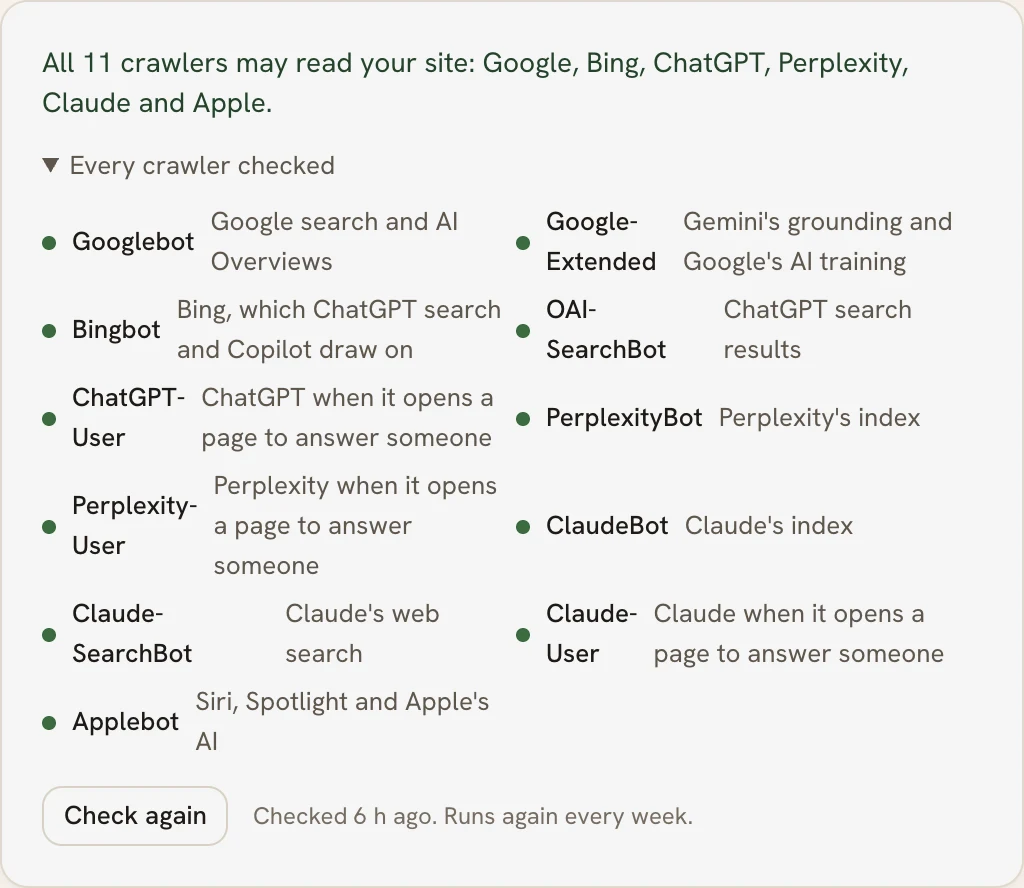
When we built PARCHMNT's crawler check, we filed Google-Extended under Gemini rather than Search for this reason. We show it next to Googlebot so the two are never confused.
Does Google-Extended affect AI Overviews and AI Mode?
No, it does not. AI Overviews and AI Mode are features of Google Search. Google's "AI features and your website" page says they are governed by the Googlebot rules and the snippet controls, and it mentions the token once, as the way "to limit AI training and grounding in some of Google's other systems".
The page says AI "is built into Search and integral to how Search functions", so "robots.txt directives for Googlebot is the control" for Search. To limit what appears, it points to nosnippet, data-nosnippet, max-snippet and noindex. A separate page adds that you can manage inclusion in AI Overviews and AI Mode with the Search generative AI control in Search Console. Those are the controls for AI Overviews; the Google-Extended token is not among them.
| Control | Where | What Google says it affects | Touches rankings? |
|---|---|---|---|
Disallow for Googlebot |
robots.txt | Crawling for Search, including AI Overviews | Yes: Googlebot is the Search crawler |
noindex |
meta tag or header | Whether the page is indexed | Yes: the page leaves Search |
nosnippet, max-snippet, data-nosnippet |
meta tag or HTML | How much text Search and its AI features show | No; display controls |
| Search generative AI control | Search Console | Inclusion in AI Overviews and AI Mode | Google's page does not say |
Disallow for Google-Extended |
robots.txt | Gemini training and grounding | No, per Google |
What happens in Gemini when you block Google-Extended?
Blocking Google-Extended tells Google not to use your content to train future Gemini models or to ground answers in Gemini Apps and on Vertex AI. That is the real cost of the block. Grounding is how Gemini pulls pages from the Search index into an answer at prompt time, and your pages are no longer supposed to be among them.
What that costs in visits, nobody publishes. Google gives no figure for how often Gemini grounds an answer in a given site, and we have not seen a measurement that separates Gemini citations from the rest. The decision rests on two things you can know: what your content is worth to you as training material, and whether being cited inside Gemini matters to your business. Our post on getting your business recommended by Gemini covers the second half.
Keep one distinction straight. AI Overviews in Search and answers inside the Gemini app are different products with different controls. A business can block Google-Extended and still appear in AI Overviews, because Google says the token does not affect inclusion in Search.
How do you block or allow Google-Extended in robots.txt?
Add a group that names the token. User-agent: Google-Extended followed by Disallow: / blocks it across the whole site; Allow: /, or no group at all, leaves it allowed. Keep the token in its own group so it never shares a line with Googlebot.
User-agent: Google-Extended
Disallow: /

User-agent: Googlebot
Allow: /
Three rules from RFC 9309, the Robots Exclusion Protocol the IETF published in September 2022, explain how the file is read:
- Matching of the product token is case-insensitive, so
google-extendedandGoogle-Extendedare the same line. - A crawler with no group of its own follows the
User-agent: *group. ADisallow: /under*with no Googlebot group above it blocks Googlebot. - If the server answers the robots.txt request with a 5xx error, a crawler "MUST assume complete disallow". A robots.txt that errors is a locked door until it loads again.
After the change, check the live file in a browser rather than in your editor, because plugins and caches can serve a different version. Our two-minute robots.txt check for AI crawlers covers the other companies' tokens.
Should you block Google-Extended?
Block Google-Extended if you do not want your content used to train Gemini and you accept that Gemini's grounded answers are not supposed to draw on your pages. Leave it open if being cited inside Gemini matters to you. Your Google rankings stay where they are either way, by Google's own account.
The cases split cleanly. A publisher whose text is the product, and who is negotiating over training, has a clear reason to block. A small business that wants to be found usually has a reason to leave it open: allowing training costs nothing in Search, and blocking grounding might cost a citation. A site in between can block the token on its archive and allow it on the pages it wants found, because the token takes paths like any other group.
PARCHMNT is a writing tool that researches what ranks for a search, writes the page, checks every claim and tracks where it lands in Google and AI answers. Its crawler check reads a site's robots.txt once a week the way each crawler would, Googlebot and Google-Extended included, and names the rule behind any closed door. We built it because a block is often a template's decision rather than the owner's.
Key takeaways
- Google says Google-Extended "does not impact a site's inclusion in Google Search nor is it used as a ranking signal in Google Search".
- The token controls Gemini training and grounding, nothing else; it has no user agent of its own.
- AI Overviews and AI Mode are Search features controlled by Googlebot rules, snippet controls and a Search Console setting, not by Google-Extended.
- The ranking risk in a "block AI" template is a
User-agent: *group withDisallow: /, which catches Googlebot. - Block the token if training matters more to you than Gemini citations; otherwise leave it open.
Frequently asked questions
Does Google-Extended have its own user agent string?
No, it does not. Google's crawler list says Google-Extended "doesn't have a separate HTTP request user agent string". Crawling is done with Google's existing user agents, and the token exists only in robots.txt, where it is read as a control. You will not find Google-Extended in your server logs, so only the file can tell you whether the token is set.
How is Google-Extended different from GoogleOther and Google-CloudVertexBot?
GoogleOther is a generic crawler Google's product teams use, and Google says its robots.txt rules do not affect any specific product. Google-CloudVertexBot crawls sites at their owners' request to build Vertex AI Agents and has no effect on Search. Google-Extended is not a crawler at all. It is a token that governs how content fetched by other Google agents may be used for Gemini.
Do you also need an llms.txt file for Google?
No, you do not. Google's changelog notes on June 15, 2026 that llms.txt files "aren't needed for Google Search (and won't negatively or positively impact your visibility or rankings)". It adds that keeping one for other systems is fine. Google's AI features page says the same about AI text files and special markup: nothing extra is required to appear.
How long does a robots.txt change take to apply at Google?
Google publishes no figure for the Google-Extended token itself. Its AI features page says that after a preview control changes, recrawling "can take anywhere from several days to several months", depending on how often Google decides a page needs refreshing. You can request a recrawl. Expect the same order of time for a token change, and check the live file first.
Does blocking Google-Extended hurt my rankings? The short version
No, and Google says so in writing. The token governs Gemini training and grounding, while Googlebot, the snippet controls and Search Console govern Search and its AI features. Decide about Gemini on its own terms, keep Googlebot out of any block list, and read the live file after every change. If you would rather have the file read for you every week, try one article free and the crawler check comes with it.
Sources
- doesn't have a separate HTTP request user agent string
- September 28, 2023
- updated the description on February 8, 2024
- is used primarily to manage crawler traffic to your site
- to limit AI training and grounding in some of Google's other systems
- manage inclusion in AI Overviews and AI Mode with the Search generative AI control in Search Console
- RFC 9309, the Robots Exclusion Protocol the IETF published in September 2022
This post was written and checked with the same rules PARCHMNT applies to every page it writes for a customer: researched against what ranks today, answer first, every figure with a source.
Try 1 article free