How to Write a Comparison Page That Ranks (and Gets Cited by AI)
To write a comparison page that ranks, compare real alternatives on the same criteria and say who should choose each one. Put the comparison in a table, and back every row with evidence you gathered yourself. A page that declares its own product the winner on every row reads as an ad, and neither Google nor AI assistants treat ads as sources.
A comparison page is a page that weighs two or more options a buyer is choosing between: "X vs Y", "best X for Y", "X alternatives". This post is built on Google Search Central's guidance on writing reviews, its page on the reviews system, and the Princeton research into what generative engines cite. It also draws on what we see when we ask an assistant a "which should I use" question.
How do you write a comparison page that ranks?
A comparison page ranks when it does the job the searcher came for, which is deciding. Google's reviews system judges this kind of page, and Google's guidance on writing reviews is the closest thing to a published rulebook for it. The page has to be honest, specific and first-hand, in that order.
Google's documentation on its reviews system says the system "is designed to evaluate articles, blog posts, pages or similar first-party standalone content". That content is written to give "a recommendation, giving an opinion, or providing analysis". The same page says: "Reviews can be about a single thing, or head-to-head comparisons, or ranked-lists of recommendations." A "vs" page and a "best for" list are judged like reviews, and rewarded for "insightful analysis and original research".
Four things follow, and the rest of this post takes them in turn:
- Real alternatives, named. A comparison with a straw man is not a comparison.
- The same criteria for every option, in a table, so the reader can see the trade.
- A verdict by reader, not a single winner: who should choose each one.
- Evidence you gathered yourself, because a rewritten feature list is what the other nine results already are.
Which comparison searches should you write for?
Write for the comparison searches your customers actually type, and only where your product honestly belongs among the options. For Clockbird, a fictional time-tracking app we use as an example, that means "Clockbird vs a spreadsheet", "best time tracker for freelancers" and "Clockbird alternatives". It does not mean "best accounting software".
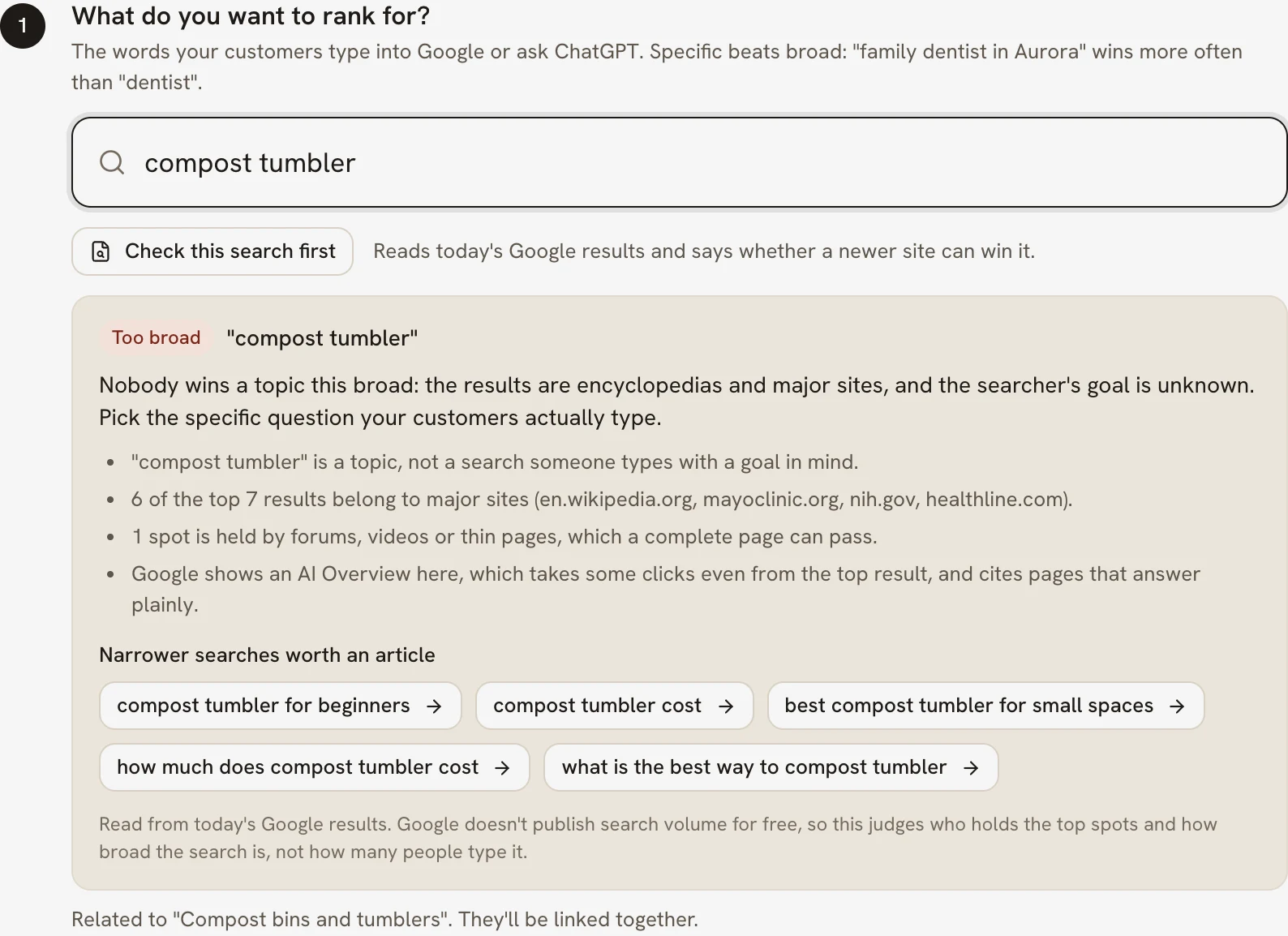
The three shapes want different pages. "X vs Y" is two named options and a reader who already knows both. "Best X for Y" is a ranked list for one audience. For those, Google asks writers to "ensure there is enough useful content in your ranked lists for them to stand on their own". "X alternatives" is written for someone leaving X, so it has to say what X does badly and for whom.
Read the first page before you write, as for any keyword; our guide to checking whether a keyword is worth writing about has the method. In our experience, "vs" searches are often held by forum threads and thin affiliate pages. That makes them winnable for a page with real testing, and it is an observation from reading results, not a statistic.
PARCHMNT is a writing tool that researches what ranks for a search, writes the page, checks every claim and tracks where it lands in Google and AI answers. Its content plan includes two or three comparison or "best ... for ..." searches where the business honestly belongs, because those are the pages assistants build recommendations from.
How do you compare honestly when one option is yours?
Say at the top that one option is yours, use the same criteria for every option, concede the rows where the alternative wins, and date every price. A page where your product loses two rows out of eight is more convincing than one where it wins all eight. It is also the only kind that gets cited.
Google's page on helpful content asks whether a page shows "expertise that comes from having actually used a product or service". That is hard to answer yes to from a competitor's pricing page.
Three rules we apply:
- Never state a competitor's price or feature from memory. Link their pricing page and write the date you checked: "as of October 2026".
- Concede in plain words. "If you need offline time entry, choose the spreadsheet" costs nothing and buys trust for every other row.
- Disclose what you earn. On affiliate links, the Federal Trade Commission says "the same guidance applies anytime you endorse a product and get paid through affiliate links". It adds that "the closer the disclosure is to your recommendation, the better", and that consumers may miss a line at the bottom of a page.
What goes in the comparison table?
The comparison table holds one row per criterion a buyer cares about, one column per option, and short cells a reader can scan in ten seconds. It sits high on the page, after the opening answer, because it is the part people came for and the part results pages and assistants lift.
Here is the shape, with Clockbird as the fictional example:
| Criterion (as of October 2026) | Clockbird | A spreadsheet | A free timer app |
|---|---|---|---|
| Best for | Freelancers who bill by the hour | One person with a few clients | Tracking time without invoicing |
| Setup | Ten minutes, in our test | None, if you already use one | Two minutes |
| Rounding and invoicing | Built in | Manual formulas | Not included |
| Works offline | No | Yes | Yes |
| Price | Paid, per person, monthly | Free with office software you own | Free |
Three rules for the cells. Measure what can be measured. Google asks writers to "share quantitative measurements about how something measures up in various categories of performance", so "ten minutes, in our test" beats "easy". Avoid rows that are all ticks, because a row where every option passes tells the reader nothing. And date the table in its heading, so a reader in 2027 knows what they are looking at.
How do you show first-hand evidence?
First-hand evidence is anything that proves you used the options: your own screenshots, the times you measured, the export you ran, the bug you hit. Google's guidance on reviews asks for it directly, and it is what separates a comparison page from a rewritten feature list.
Google's page on writing high quality reviews says to "provide evidence such as visuals, audio, or other links of your own experience with what you are reviewing". When you name something the best, it says to "include why you consider it the best, with first-hand supporting evidence." And it asks writers to "explain which might be best for certain uses or circumstances", which is the "who is it for" question in Google's own words.
The simplest way to meet that last point is a section headed "Which is right for you?" before the key takeaways. Give each option one or two sentences: who should choose it and who should not. We made this a rule in PARCHMNT's checks because the passage answers the real question behind every comparison search. It is also the passage assistants most often quote whole.
Why do AI assistants build recommendations from comparison pages?
Ask ChatGPT, Perplexity or Gemini which time tracker a freelancer should use and read the sources: comparison articles and "best of" lists appear again and again. That is an observation anyone can repeat in a minute, not a published statistic, and it has a plain cause. Those pages already hold the answer in the shape the question takes.
The research on generative engine optimization (GEO) backs the shape. Aggarwal and colleagues at Princeton University found in 2023 that adding citations, quotations and statistics to a page can boost visibility by up to 40 percent in generative engine responses. A comparison table with measured cells and dated, linked prices is statistics and citations in one block.
Your page is one voice, though. What comparison pages on other sites say about you matters as much, which is why a competitor can be recommended ahead of you even when your page is better. Our guide to getting a website recommended by ChatGPT covers that side.
Key takeaways
- Google's reviews system judges "vs" pages and "best for" lists like reviews, and rewards original research by people who know the topic.
- Name real alternatives, score them on the same criteria, and concede the rows you lose.
- Put the comparison in a dated table with measured cells, high on the page.
- Add a "Which is right for you?" section that says who should choose each option.
- Comparison pages are what assistants build recommendations from, so write yours fairly and get into other people's.
Frequently asked questions
Should you name competitors on your own website?
Yes, by their real names, if you compare them fairly. A page that says "other tools" instead of naming them cannot rank for the "vs" search, because the name is the search. Link the competitor's own pricing and feature pages rather than describing them from memory, and say when you checked.
Do you need a separate page for each competitor?
One page per search. "Clockbird vs a spreadsheet" and "Clockbird vs a free timer" are different searches with different readers, so they deserve separate pages that link to each other. A single page listing ten rivals usually ranks for none of them, because it is thin on each. That is our observation from reading results, not a published figure.
How often should a comparison page be updated?
Whenever a price or feature in the table changes, and on a fixed check otherwise. We recheck every competitor row quarterly, because a table that is wrong about a rival's price is the fastest way to lose a reader's trust. Change the date in the table heading only when you have actually rechecked the rows.
How to write a comparison page that ranks, in one list
Pick the comparison searches where you honestly belong and name the real alternatives. Score them in a dated table on the same criteria, concede what you lose, show your evidence, and tell each kind of reader which to choose. If you want the comparison searches found and the page written and checked to those rules, try one article free.
Sources
- is designed to evaluate articles, blog posts, pages or similar first-party standalone content
- ensure there is enough useful content in your ranked lists for them to stand on their own
- expertise that comes from having actually used a product or service
- the same guidance applies anytime you endorse a product and get paid through affiliate links
- can boost visibility by up to 40 percent in generative engine responses
This post was written and checked with the same rules PARCHMNT applies to every page it writes for a customer: researched against what ranks today, answer first, every figure with a source.
Try 1 article free