How to Write an FAQ Section That Ranks After Rich Results Ended
To write an FAQ section that ranks, give it only the questions your sections do not already answer. Phrase each as a person would type it, answer in the first sentence, and keep each answer to 40 to 80 words. As of October 2026, FAQ rich results no longer exist in Google Search, so the FAQ earns its place as quotable text, not through schema.
An FAQ section is a list of real questions and short answers at the end of a page, or on a page of its own. This post is built on Google Search Central's changelog, its 2023 announcement on FAQ rich results, and schema.org's definition of FAQPage. It also draws on the Princeton paper on what generative engines quote, and on the FAQ rule we built into our own checks.
Which questions earn a place at the end of a post?
A question earns a place in the FAQ when no section on the page already answers it and a real person asks it. The rule is simple, and it doubles as the test: if the question could be a heading in the body, it belongs in the body. The FAQ is for the loose ends: the edge case, the "what if", the follow-up an assistant would ask next.
Where the questions come from: the "People also ask" box for your search, the related searches at the bottom of the results, forum threads, and your own inbox. Keep the ones your sections leave open, and drop the rest. If nothing is left open, drop the FAQ. An FAQ that repeats the headings adds length, not value. Google's helpful content page asks whether a page provides "a substantial, complete, or comprehensive description of the topic", not whether it has an FAQ.
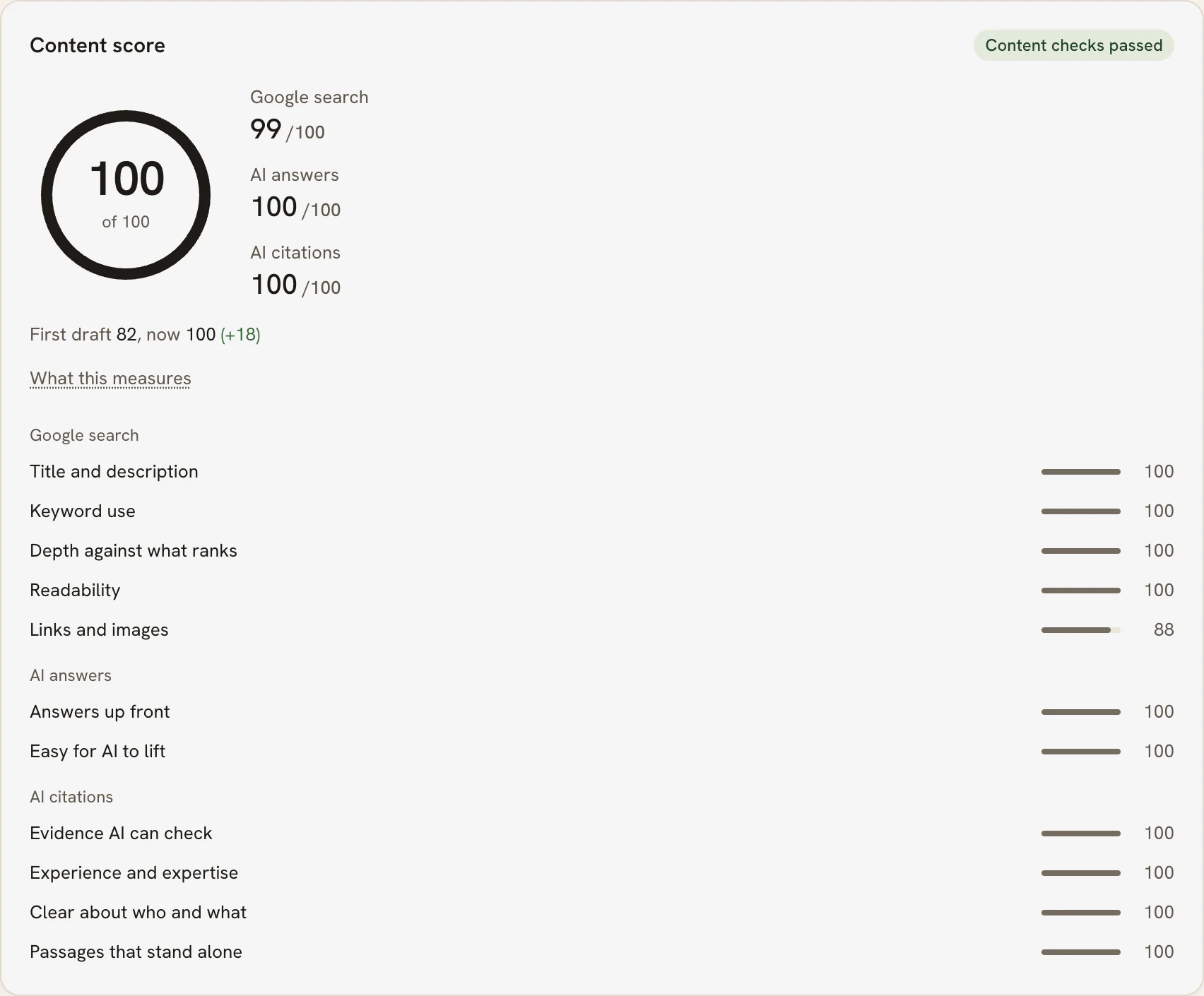
PARCHMNT is a writing tool that researches what ranks for a search, writes the page, checks every claim and tracks where it lands in Google and AI answers. One of its 41 content checks reads the FAQ against the H2s. A question that repeats a section is marked down. A page whose sections answer everything passes with no FAQ at all, and the questions still open are listed for the writer. We added that check after seeing drafts whose FAQ was the headings asked again.
How long should each answer be?
Forty to eighty words, with the complete answer in the first sentence and the reason or exception after it. That answer length is long enough to be complete and short enough to be lifted whole into a snippet or an AI answer. A 200-word FAQ answer is a section wearing the wrong heading.
Google's guide to its ranking systems describes a passage ranking system. It is "an AI system we use to identify individual sections or 'passages' of a web page", which is why a self-contained question and answer can rank for its question on its own. The research on generative engines points the same way. Aggarwal and colleagues at Princeton University found in 2023 that adding citations, quotations and statistics can boost a page's visibility in generative engine responses by up to 40 percent.
Three habits for the answer itself:
- Answer, then explain. "Yes, if the video has captions. YouTube builds the transcript from them." Not "This is a great question".
- Name the subject. "FAQ schema is harmless" quotes well; "It is harmless" does not, because the "it" is lost when the passage is lifted.
- One linked fact or one concrete example per answer, where it helps the reader act.
What did Google change in 2023 and 2026?
Google restricted FAQ rich results to government and health sites in August 2023 and switched them off for everyone on May 7, 2026. Those were the expandable questions Google used to show under a result. As of October 2026, no site gets them, so an FAQ earns rankings and citations like any other text, not extra space in results.
| Date | What Google did | Source |
|---|---|---|
| August 8, 2023 | Announced that "FAQ (from FAQPage structured data) rich results will only be shown for well-known, authoritative government and health websites" | Google Search Central blog |
| September 14, 2023 | Updated the FAQ structured data documentation to say the feature "is only shown for well-known, authoritative government and health websites" | Google Search Central changelog |
| May 8, 2026 | Added a deprecation notice: "This feature will no longer appear in Google Search starting May 7, 2026" | Google Search Central changelog |
| June 15, 2026 | Removed the FAQ rich result documentation, because "the FAQ rich result feature is no longer shown in Google Search results" | Google Search Central changelog |
In the 2023 announcement, Google's John Mueller wrote that "for all other sites, this rich result will no longer be shown regularly". He added that the change "should not be considered a ranking change". That last line matters: the FAQ text itself never stopped counting, only the display did. Our guide to getting a business mentioned in Google AI Overviews covers where the question-and-answer shape pays off now.
Should you still add FAQPage schema?
Adding FAQ schema does no harm and, in Google Search, now does nothing visible either. Keep it if your publishing tool adds it for free; do not spend an hour on it, and do not expect it to move anything.
Schema.org defines the type in one line: "A FAQPage is a WebPage presenting one or more 'Frequently asked questions'". When Google restricted the rich result in 2023, Mueller said there was "no need to proactively remove it". His reason: "Structured data that's not being used does not cause problems for Search, but also has no visible effects in Google Search." Nothing in Google's 2026 notices changes that.
Whether other engines and assistants read FAQPage markup is something nobody publishes, Bing and the assistant makers included. Treat the markup as a label, not a lever: the text under it is what gets read. Our post on what structured data a blog post needs covers the types that still earn their place.
How do you write a questions page that ranks on its own?
A questions page ranks on its own when its questions are about one topic a person searches for, its headings are phrased the way people type, and each answer stands alone. The pages it supports link to it. A support FAQ with sixty mixed questions ranks for nothing, because it answers no single search.
Clockbird, a fictional time-tracking app we use as an example, would not publish one "FAQ" page. It would publish "Clockbird billing questions" and "Clockbird and your accountant", each on a single topic. Each question is an H2 or H3 phrased as typed: "Can I round time to the nearest 15 minutes?" rather than "Rounding".
Question headings are also an accessibility rule. The W3C's guideline 2.4.6 asks that "headings and labels describe topic or purpose", because "when headings are clear and descriptive, users can find the information they seek more easily". The question is the search, so the heading has to be the question.
Three more rules. One question per answer, so each passage answers one thing. And link each answer to the page that goes deeper, so the FAQ page passes readers and authority onward. Our guide to writing a blog post that gets quoted by AI covers the same passage rules for the body.
Where do question-and-answer blocks show up in AI answers?
Ask Perplexity or ChatGPT a specific question and read the cited passage. In our experience it is often a short question-and-answer block from the end of a page, quoted nearly whole. That is an observation anyone can repeat, not a statistic. It follows from how these systems work: they retrieve passages, and an FAQ answer is a passage with its question attached.
Two things make an FAQ answer more likely to be the one lifted. It names its subject, so it makes sense out of context, and it contains something checkable: a date, a figure with a link, a quotation. All three assistants show their sources, so ask the question your FAQ answers and see whether your answer is what comes back.
Key takeaways
- An FAQ earns its place only with questions the sections do not answer; otherwise leave it out.
- Forty to eighty words per answer, the answer in the first sentence, the subject named.
- FAQ rich results were restricted to government and health sites in August 2023 and ended for everyone on May 7, 2026, by Google's own changelog.
- FAQ schema is harmless and, in Google, now invisible; keep it only if it is free.
- An FAQ answer is a passage with its question attached, which is why assistants quote them.
Frequently asked questions
Should an FAQ be its own page or part of the post?
Part of the post when the questions are follow-ups to that post; its own page when they are about a product or process people search for directly. A post's FAQ supports the post's search; an FAQ page targets its own. Never both for the same questions, because two pages answering one search compete with each other.
How many questions should an FAQ section have?
Three to six in a blog post, and only as many as are genuinely left open. Beyond six, the FAQ is doing the body's job and the questions deserve sections of their own. On a standalone FAQ page about one topic, ten to fifteen is practical; past that, split the page by subtopic. These are our working numbers, not a published rule.
Can FAQ answers sit inside accordions?
Yes. Google's changelog noted in July 2021 that "clicking an expandable section to view the answer is a valid use case". The condition is that "the user must be able to access the answer on the page". The text must be in the HTML, not fetched on click. Google's documentation on lazy loading says "Google Search does not interact with your page", so an answer that loads only on a click may never be read.
How to write an FAQ section that ranks, in one list
Keep only the questions your sections leave open, phrase them as typed, answer in the first sentence in 40 to 80 words, name the subject, and stop expecting rich results. If you want the FAQ checked against the body before you publish, try one article free.
Sources
- a substantial, complete, or comprehensive description of the topic
- an AI system we use to identify individual sections or 'passages' of a web page
- can boost a page's visibility in generative engine responses by up to 40 percent
- Google Search Central blog
- Google Search Central changelog
- A FAQPage is a WebPage presenting one or more 'Frequently asked questions'
- headings and labels describe topic or purpose
- Google Search does not interact with your page
This post was written and checked with the same rules PARCHMNT applies to every page it writes for a customer: researched against what ranks today, answer first, every figure with a source.
Try 1 article free