Should I Write One Page per Keyword or Several per Page?
Write one page per search, not per keyword, and let the page rank for every keyword that means the same thing. The question "should I write one page per keyword or one page for several keywords" has a plain answer: one page per intent. A second keyword deserves its own page only when Google's first page for it looks different.
This post is built on Google's SEO Starter Guide, How Search Works pages, canonicalization documentation and helpful content guidance, plus what we see in Google Search Console for this journal. As of October 2026, all four say the same thing.
How does Google decide which searches a page ranks for?
Google ranks a page for the searches it answers best, judged query by query, not for a list of keywords the writer chose. Its systems work out the intent behind a query, then look for pages whose content matches it.
Google's SEO Starter Guide says that "Google's language matching systems are sophisticated and can understand how your page relates to many queries". Its How Search Works pages add that "the most basic signal that information is relevant is when content contains the same keywords as your search query".
Open Google Search Console, pick a page in the Performance report, and read its Queries tab: one post appears for dozens of phrasings the writer never typed. On our own posts the list is longer than the brief that produced them. That is an observation anyone can repeat, not a statistic.
Should every keyword get its own page?
No. A keyword that means the same thing as another, or asks the same question in other words, belongs on the same page. A separate page for it creates two pages that compete. Only a keyword with a different intent, a different audience, or a question big enough for its own steps earns a page.
The threads that rank for this question are Moz forum posts from a decade ago. Google's SEO Starter Guide asks you to "ensure that each piece of content on your site is only accessible through one individual URL". Its canonicalization documentation says that when pages "seem to be the same or the primary content very similar, it clusters them together" and shows one as the canonical.
Take Clockbird, a fictional time-tracking app we use as an example. "Billable hours tracker" and "billable hours tracking app" are one page: same person, same want. "How to track billable hours" and "best billable hours tracker" are two: steps against a comparison, and the first pages on Google for them look nothing alike.
When does a second keyword deserve a second page?
A second keyword deserves a second page when Google's first page for it is a different set of results, or when the person asking wants a different kind of page. It also deserves one when the answer needs its own steps, table or examples. Run the two first pages test before deciding.
- Search both phrases in a private window.
- Compare the ten results. By our rule, six or more of the same pages means one intent and one page; mostly different pages means two.
- Compare the kinds of page: a how-to guide, a list, a product page and a forum thread answer different wants.
- Read the People Also Ask boxes. The same questions under both searches means the same page.
| Situation | Same page or new page | Why |
|---|---|---|
| Synonyms ("time tracker", "time tracking tool") | Same page | Google matches both to one intent |
| Same question, different wording ("how to track billable hours", "how do I log billable time") | Same page | One answer; a second page competes with the first |
| Same subject, different intent ("how to track billable hours" vs "best billable hours tracker") | New page | Steps against a comparison; the first pages differ |
| Same question, different audience ("for freelancers" vs "for law firms") | New page if the answer differs | Different rules, examples and tools; otherwise a section |
| A sub-question that needs its own steps ("how to round billable hours") | New page, linked from the first | Big enough to be complete alone |
| A location ("time tracking consultant in Denver") | New service page | Local intent needs a local page |
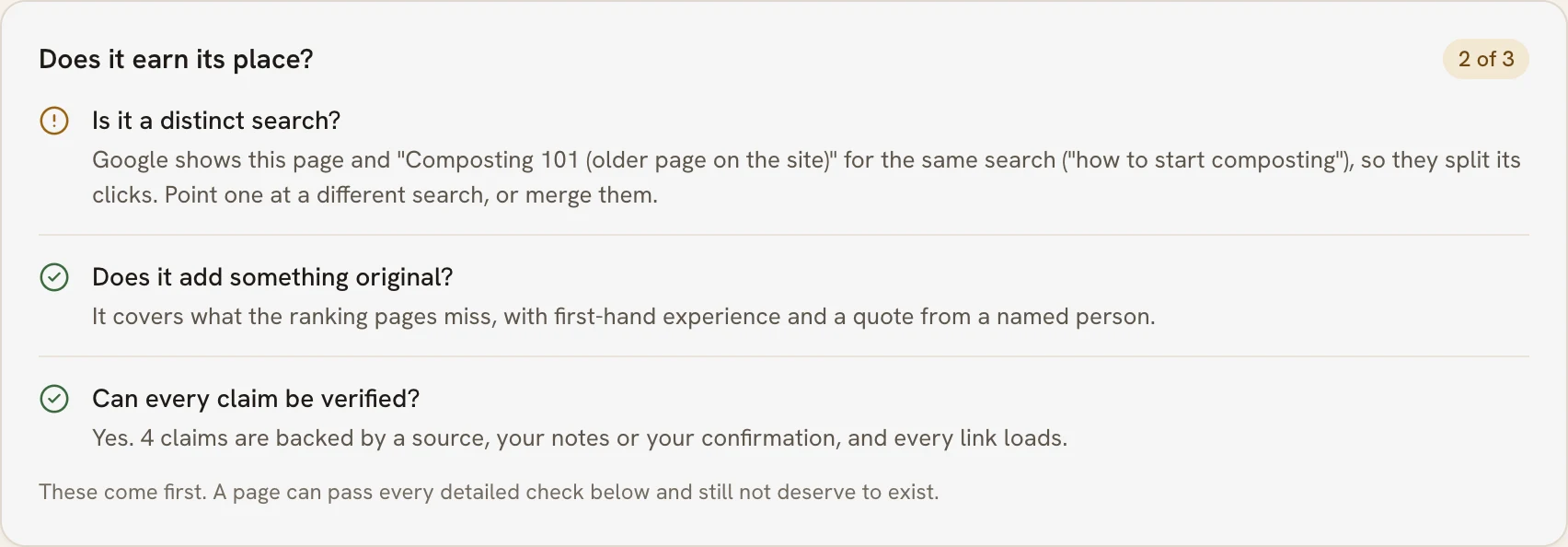
PARCHMNT is a writing tool that researches what ranks for a search, writes the page, checks every claim and tracks where it lands in Google and AI answers. Before an article is written, its duplicate check compares the new search with the brand's earlier articles and asks whether this is a distinct search.
What happens when you write one page for several keywords?
A page written for several unrelated keywords usually ranks for none of them well, because for each search there is a competitor page that answers only that search. A page that is a third about each of three things is a third as complete as each rival.
Google's helpful content page asks whether content provides "a substantial, complete, or comprehensive description of the topic", in the singular. A page for three topics fails that test three times. Length does not rescue it; our post on how many words a blog post should be to rank explains why completeness, not count, is what Google describes.
The usual symptom is keyword cannibalization in reverse: one page for two searches, ranking at position fifteen for both. The exception is a genuine hub, a broad page that introduces a subject and links to the specific pages that answer each question. A hub is one intent, the overview, and earns its place.
How do you use secondary keywords on one page?
Use secondary keywords where they carry meaning: in the heading of the section that answers that phrasing, in the defining sentence, and in the FAQ for questions asked in other words. Do not repeat them to hit a count. Google reads the page's meaning, and readers notice padding.
Collect the related searches and People Also Ask questions for your target keyword. A phrasing that needs its own answer gets a section heading; a synonym appears once, where it reads naturally; a question nobody else answers goes in the FAQ. Google's Starter Guide warns that "excessively repeating the same words over and over (even in variations) is tiring for users", and that keyword stuffing is against its spam policies.
We apply the same rule to our own posts: the brief lists the related phrases, the checks confirm the body uses most of them once, and only repetition is flagged. When a sub-question has its own page, link to it from the sentence that raises it, with the phrase as the anchor; our post on whether internal links help a page rank covers what that does.
Which is right for you: one page or several?
Choose by intent, then by size. One page when the keywords ask the same thing, even in very different words. Several pages when the first pages differ, when the audiences need different answers, or when a sub-question needs more than a section. In doubt, write one complete page first and split later, only if Search Console shows a query it cannot satisfy.
- One page: synonyms, rephrasings, singular and plural, "how to" and "how do I", and a topic cluster's small variations.
- Several pages: a how-to and a buying comparison, two audiences with different rules, a sub-question with its own steps, and any location.
- A hub plus pages: a broad subject your business owns, where the hub introduces and the pages answer.
Key takeaways
- Google ranks a page for the searches it answers best; its Starter Guide says one page can relate to many queries.
- Write one page per intent. Synonyms and rephrasings share a page; a different want, audience or sub-question gets its own.
- Run the two first pages test: mostly the same results means one page, mostly different means two.
- Use secondary keywords once, where they mean something, and link sub-questions to their own pages.
Frequently asked questions
Can one page rank for hundreds of keywords?
Yes, when the keywords are phrasings of one intent. Search Console's Queries tab for a single page shows the spread: the target keyword, its synonyms, and questions that contain it. The count depends on how many ways people ask the question, not on how many keywords the writer worked in.
Is keyword cannibalization real?
Yes, in the narrow sense. Two of your pages shown for the same query split the clicks and the links one would hold, and Google clusters near-duplicates and shows one. The scare version, that any overlap between two pages hurts, is not supported by Google's documentation. Our post on telling whether two pages compete for the same search shows how to check.
How many keywords should a page target?
One search, together with its synonyms and the sub-questions that fit in a section. When a related phrase would need its own steps or its own comparison to answer well, it has become a second search and deserves a second page.
Does one page per keyword create duplicate content?
Not when each page answers a different intent. It does when two pages answer the same question in different words; Google then clusters them and picks one as the canonical, possibly not the one you wanted. You can state your preference with the canonical link relation, which RFC 6596 says "specifies the preferred IRI from resources with duplicative content", though Google treats it as a hint.
Should I write one page per keyword or one page for several keywords? The short version
One page per intent, with its synonyms on board, and a second page only when the first page on Google changes. If you want the duplicate check run before each article, and the research that finds the related phrases done for you, try one article free.
Sources
- Google's language matching systems are sophisticated and can understand how your page relates to many queries
- the most basic signal that information is relevant is when content contains the same keywords as your search query
- seem to be the same or the primary content very similar, it clusters them together
- a substantial, complete, or comprehensive description of the topic
- specifies the preferred IRI from resources with duplicative content
This post was written and checked with the same rules PARCHMNT applies to every page it writes for a customer: researched against what ranks today, answer first, every figure with a source.
Try 1 article free