How Many Words Should a Blog Post Be to Rank? What Google Says
A blog post should be as many words as a complete answer to its search takes. No word count makes a post rank. Google says it has no preferred length, and the study most often quoted for a target found no direct relationship between word count and rankings. Complete is the target, and complete can be checked.
This post is built on Google Search Central's helpful content guidance and two statements by Google's John Mueller, which we opened and quote word for word. It also uses Backlinko's analysis of 11.8 million search results and what we changed in our own checks when we removed a word count target.
What does Google say about word count?
Google says it has no preferred word count, more than once and in writing. Its helpful content page asks the question outright and answers it in parentheses, and John Mueller has repeated the point for years.
The exact wording on Google's helpful content page is "Are you writing to a particular word count because you've heard or read that Google has a preferred word count? (No, we don't.)" The same page asks whether content provides "a substantial, complete, or comprehensive description of the topic", the question that replaces the count.
In July 2018 he wrote on Twitter that "Some pages have a lot of words that say nothing", as reported by Barry Schwartz at Search Engine Roundtable. The fuller passage:
Word count is not indicative of quality. Some pages have a lot of words that say nothing. Some pages have very few words that are very important & relevant to queries. You know your content best (hopefully) and can decide whether it needs the details.
In August 2024 he put it more bluntly on LinkedIn: "Nobody at Google counts the links or the words on your blog posts", again reported by Search Engine Roundtable. As of October 2026, no Google page says otherwise.
Where did the 1,500 to 2,500 word targets come from?
The popular targets come from averages of pages that already rank, not from anything Google said. Backlinko analyzed 11.8 million results and found that the average top ten result had 1,447 words; vendors turned numbers like that into a range to aim for. The same page says the study found no direct relationship between word count and rankings.
An average of winners describes the winners and hides the spread. A first page for "how to start a bakery" is long because the question is big; one for "what time zone is Denver" is short because the question is small. Averaging them gives a number that fits neither, which is why the ideal blog post length is a property of the search.
| The claim | What the evidence says | Source |
|---|---|---|
| Google prefers posts over 1,500 words | Google says it has no preferred word count | Google's helpful content page |
| Top results average 1,447 words, so aim for that | The same study found no direct relationship between word count and rankings | Backlinko |
| Longer means more thorough | Some pages have a lot of words that say nothing, in Mueller's words | Search Engine Roundtable |
| Short posts are thin content | Google's spam policy on scaled content is about unoriginal pages made to manipulate rankings, not length | Google's spam policies |
What does complete mean for a blog post?
Complete means the post answers the search and the questions that come with it, with nothing the searcher needs left for another page. Google's self-assessment asks for "a substantial, complete, or comprehensive description of the topic" and for "insightful analysis or interesting information that is beyond the obvious". Those are the two tests, and neither counts words.
The first test is coverage. List the questions the first page answers, add the People Also Ask box and the related searches, and read the forum threads for the questions nobody has written up. A complete answer has a sentence or a section for each, with steps, sourced numbers and tradeoffs. The second test is information gain: something the other pages lack, such as first-hand experience or a worked example.
Take Clockbird, a fictional time-tracking app we use as an example. A post on "how to round billable hours" is complete at a few hundred words: the common rounding rules, one worked invoice, what clients accept. A post on "how to start freelancing" needs several thousand, because the question contains twenty smaller ones. Both are the right length.
How do you work out the right length for your search?
Work out the length from the search, not from a target: list what a complete answer must contain, write it, and stop. The first page tells you the size of the question. If the pages that rank are short definitions, a long guide is not more complete, it is the wrong page.
- Open the top five results and note which questions each answers and which it skips.
- Add the People Also Ask questions and the related searches that share your subject.
- Answer each once, in the shortest form that is still useful: a step, a sourced figure, a tradeoff.
- Cut anything that repeats, explains the obvious, or exists to reach a number.
- Check that each section opens with its answer, because that is the passage snippets and AI assistants lift.
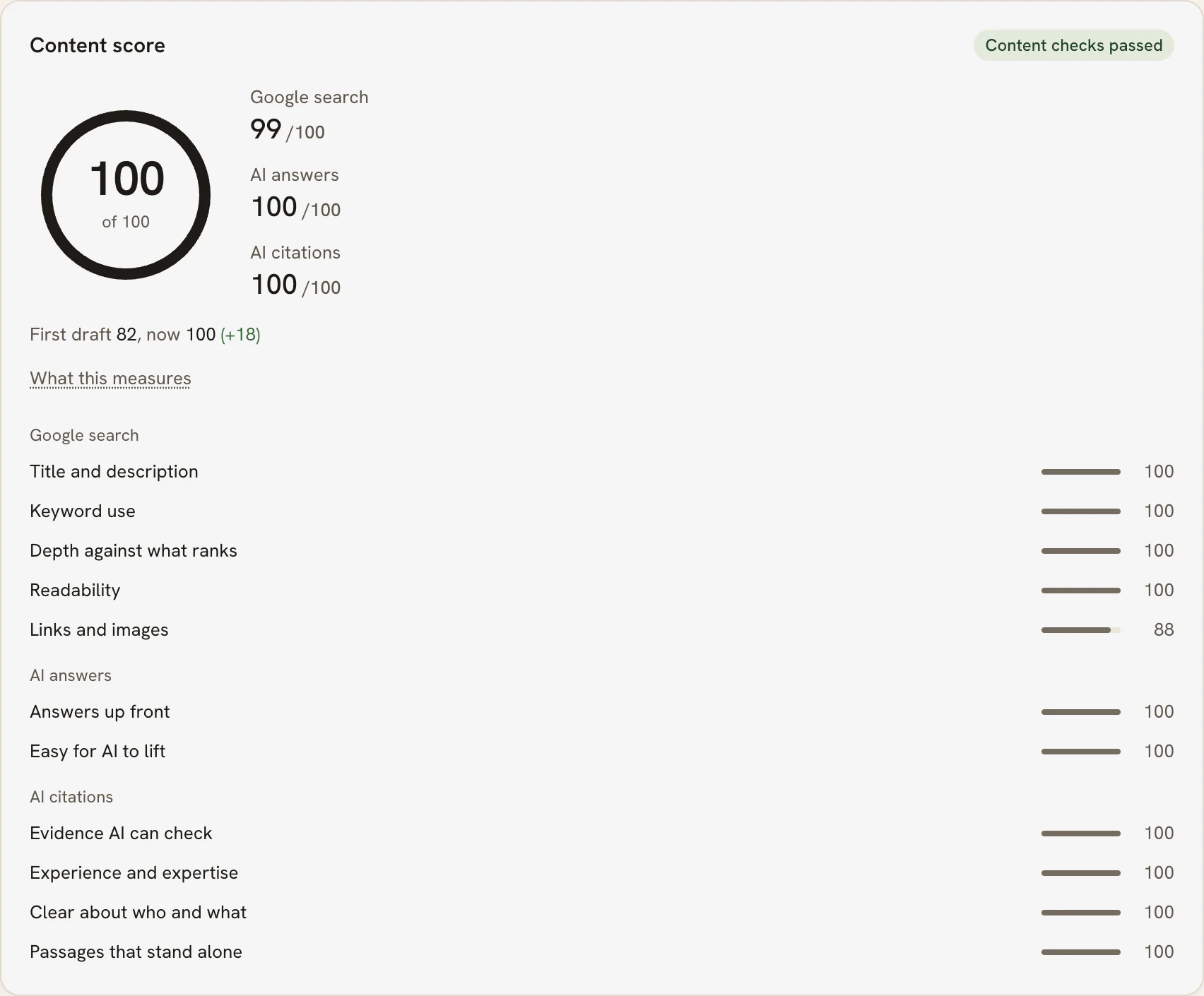
PARCHMNT is a writing tool that researches what ranks for a search, writes the page, checks every claim and tracks where it lands in Google and AI answers. Its content checks used to reward a word count near the competitors'. We removed that check because it pushed the writer toward padding. The checks now score completeness, whether the page covers the gaps and questions the research found, and flag length only when a page is under half of what ranks.
Can a blog post be too long to rank?
Yes, in practice. A post is too long for its search when the length comes from padding, repetition, or sections that answer different searches. Google does not penalize a word count, but it ranks the page that answers best, and a reader who scrolls past preamble to reach the answer has been served worse.
Google's SEO Starter Guide says "Excessively repeating the same words over and over (even in variations) is tiring for users", and that keyword stuffing is against its spam policies. Long-form content earns its length only when every section answers something the searcher asked.
The other way a post gets too long is by chasing several searches at once. A page that is a third about each of three questions is a third as complete as a rival that answers one. Our post on one page per keyword or several keywords per page covers when a second question deserves a second page. If a complete post still is not ranking, length is not the cause; our checklist on why a blog post is not ranking covers the six things that are.
Does a short blog post count as thin content?
No. Thin content, in Google's spam policies, is about pages that add no original value, not about length. A short post that answers its question with something the other pages lack is not thin; a long post assembled from them is.
Google's spam policies define scaled content abuse as "creating large amounts of unoriginal content that provides little to no value to users, no matter how it's created". Thin affiliation is content "copied directly from the original merchant without any original content or added value". Both are about originality. Google's helpful content page asks the same from the other side, whether the content provides "original information, reporting, research, or analysis". It also points to E-E-A-T, the experience, expertise, authoritativeness and trust its quality raters look for, none of which is measured in words.
Key takeaways
- Google says it has no preferred word count, in writing on its helpful content page, and John Mueller has said so publicly since 2018.
- The popular targets are averages of winning pages; the study behind the most quoted average found no direct relationship between word count and rankings.
- Complete means every question on the first page, in People Also Ask and in the forums has an answer, plus something the other pages lack.
- Thin content is about unoriginal value, by Google's definition, so a short original post is not thin.
Frequently asked questions
Does a longer post get more AI citations?
Not by being longer. AI assistants retrieve passages, not pages, so what gets lifted is a short, complete answer under a heading that matches the question. A long post with those passages gets cited; one without them does not. Our guide to writing a blog post that gets quoted by AI covers the shape.
Should you match the word count of the top results?
Use it as a rough reading of the question's size, not as a target. If the top results are all short, the search wants a short answer; if they are all long, the question has many parts. Matching the count while skipping the parts gives length without completeness.
Does word count affect featured snippets?
No. A featured snippet lifts a short passage, usually the sentences under a heading that matches the question. The length of the rest of the page is irrelevant to it. What matters is that the passage answers in full and stands alone. That is an observation anyone can repeat, not a published figure.
How many words should a blog post be to rank, in one sentence
As many as the complete answer takes, and not one more. Work from the first page to the list of questions, answer each once, and let the count land where it lands. If you want the research, the completeness checks and the writing done to that standard, try one article free.
Sources
This post was written and checked with the same rules PARCHMNT applies to every page it writes for a customer: researched against what ranks today, answer first, every figure with a source.
Try 1 article free