Short Tail vs Long Tail Keywords for a Small Business: Start Here
Short tail keywords are one or two word topics, like "time tracking"; long tail keywords are specific phrases, like "how to track billable hours as a freelancer". For a small business the choice is clear: start with the long tail. A newer site can win those searches, often within weeks, while short tail searches belong to sites with years of links.
This post is built on Google's own pages: the SEO Starter Guide, the How Search Works pages, and the Keyword Planner and Google Trends help, plus two studies we opened. The examples use Clockbird, a fictional time-tracking app, and the expectations come from reading first pages for this journal.
What is the difference between short tail and long tail keywords?
The difference is specificity, not word count. A short tail keyword names a topic and leaves the goal unknown. A long tail keyword says what the person wants: a how, a cost, a comparison, a place or a "for". The names come from the demand curve: a few searches with huge volume, then a long tail of specific ones.
The long tail is most of search. Google's How Search Works pages say that "15% of searches we see every day are new". That only happens when most searches are specific phrasings rather than a few head terms. A two-word phrase can be long tail if it is specific ("Clockbird pricing"); a six-word phrase can be a topic if it is vague.
Google's SEO Starter Guide says "Think about the words that a user might search for to find a piece of your content". It adds that its systems understand how one page relates to many queries. So a page written for one specific search also ranks for its variations; the head term does not come along.
Why should a small business start with long tail keywords?
A small business should start with long tail keywords because they are the searches it can win now, and because the people typing them know what they want. The first page for a short tail term is held by encyclopedias, major publishers and big retailers. The first page for a specific question often holds forum threads that a complete answer can pass.
Authority is why the short tail is closed. Google's How Search Works pages say its systems look for signals of expertise, authoritativeness and trustworthiness, and that links from other prominent websites are one of them. A new site has none of that yet.
Demand is the risk on the other side. Ahrefs' 2023 study of about 14 billion pages found that 96.55 percent got no traffic from Google, and the first reason it gives is that nobody searched for the topic. A long tail keyword has to be one a customer would type: "how to track billable hours as a freelancer" passes, "billable hour tracking methodology comparison" does not.
What can a newer site expect from each kind of keyword?
A newer site can expect page one on a well-chosen long tail search within weeks to a few months, and nothing on a short tail term for a year. The table shows the difference with Clockbird, our fictional time-tracking app; the third column describes the kind of page that typically ranks for each kind of search.
| Keyword | Kind | Who typically holds the first page | What a newer site can expect |
|---|---|---|---|
| "time tracking" | Short tail, a topic | Encyclopedias, software giants, review platforms | Not page one within a year; write it later as a hub |
| "time tracking app" | Short tail, buying | Big review sites and the apps themselves | Page one unlikely without links and reviews |
| "how to track billable hours as a freelancer" | Long tail, how-to | Blogs, forum threads, a video or two | Page one within weeks to months with a complete page |
| "how to round billable hours" | Long tail, specific | Forum threads, thin posts | Winnable now; often the first page to rank |
| "time tracking app for freelance designers" | Long tail, buying | Lists, thin comparison pages | Winnable with an honest comparison; converts |
| "time tracking consultant in Denver" | Local | Directories, agencies | Depends on local presence; a service page beats a post |
Position decides whether any of it pays. As of October 2026, First Page Sage's study of 1,184 domains puts the click rate for position one at 22.6 percent without an AI answer and 3.6 percent with one. Position ten gets 0.5 percent without one. A long tail page at position three earns clicks; a short tail page at position twenty-five earns nothing, whatever the volume.
How do you find long tail keywords without a paid tool?
Find long tail keywords on Google's own results page: type the short tail topic, then read the People Also Ask box, the related searches and the autocomplete suggestions. Keep the ones that share your subject, are specific, and that a customer would type.
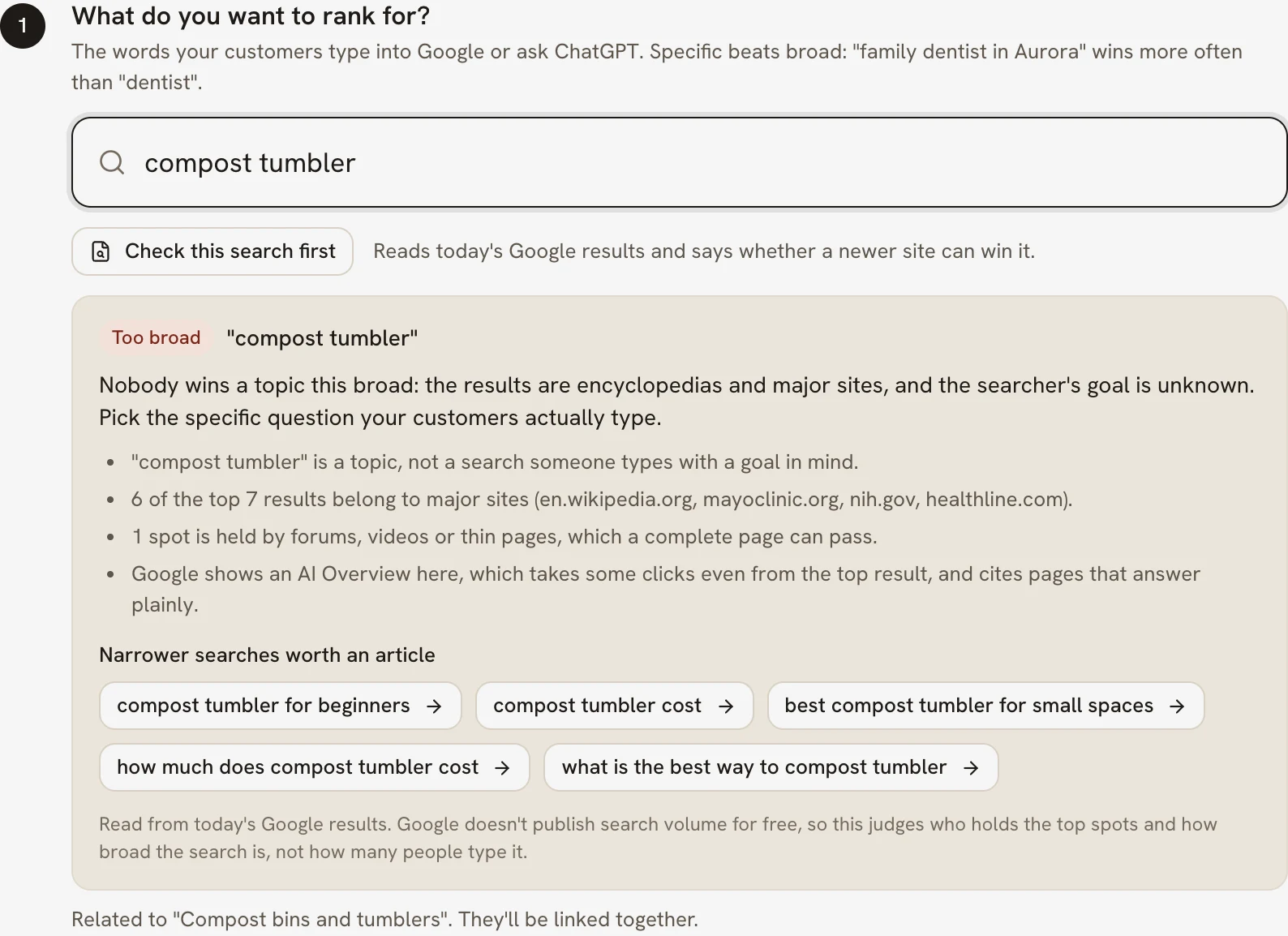
Google does not publish search volume outside Google Ads. Keyword Planner's "Avg. monthly searches" is "the average number of times people have searched for a keyword and its close variants", and the figures are rounded. Google's help also says you must enter billing information to access basic features such as keyword ideas.
Google Trends does not give counts either. Its help says each data point is "divided by the total searches of the geography and time range it represents" and scaled from 0 to 100. Paid tools estimate volume from their own data, and say so.
The first page is the better reading anyway; our post on checking whether a keyword is worth writing about gives the four verdicts. PARCHMNT is a writing tool that researches what ranks for a search, writes the page, checks every claim and tracks where it lands in Google and AI answers. Its keyword check returns "too broad" for head terms, with the narrower searches worth an article instead. After a few months, Google Search Console shows the exact queries your pages appear for, the best free list of long tail keywords.
When is a short tail keyword worth going after?
A short tail keyword is worth going after once your site has a cluster of long tail pages on the subject and links from other sites. Until then, write it as a hub that links the specific pages, and let it rank slowly.
The cluster earns the hub its place. Five pages on billable hours, each linking to a "time tracking for freelancers" guide, give that guide internal links, depth and a reason for other sites to cite it. One page per search is the rule throughout; our post on one page per keyword or several keywords per page draws the line.
Avoid the short tail for the wrong reason. Google's helpful content page asks whether you are "writing about things simply because they seem trending and not because you'd write about them otherwise". A head term chosen for its volume is the same mistake with a bigger number. For a local business, local long tail phrases belong on service pages; our guide to writing a service page that ranks locally covers that.
Which keywords are right for you?
Choose by where your site is today, not by the volume a tool shows. In our experience the honest split is this:
- A new site, or one with few links: spend the first ten articles on long tail searches whose first page has openings.
- A site with years of links and a cluster on the subject: add the short tail hub and link the cluster to it.
- A local business: local long tail phrases on service and location pages first, then posts for the questions customers ask before they call.
- A business selling one product: the buying long tail ("X for Y people", "X vs Z") before the how-to long tail, because those searches convert.
Key takeaways
- Short tail keywords are topics; long tail keywords are specific searches. Specificity, not word count, is the line.
- A small business should start with long tail searches because their first pages have openings a complete page can pass.
- Google publishes no search volume outside Google Ads, and Google Trends shows relative interest, so read the first page instead.
- Position one earns 22.6 percent of clicks without an AI answer; page one is where clicks begin.
Frequently asked questions
How many long tail pages should you write before widening?
Five to ten on one subject, one search per page, before moving to the next subject. A cluster that deep ranks for the questions it answers and builds toward the hub above it. Spreading ten pages across ten subjects leaves each alone, with no internal links and no depth.
Do long tail keywords convert better?
Often, because the intent is visible in the phrase: someone typing "time tracking app for freelance designers" is closer to choosing than someone typing "time tracking". Nobody publishes a reliable conversion figure across businesses; your own Search Console queries and analytics are the only honest source.
How long before a long tail page ranks?
Google publishes no figure. In our experience a complete page on a search with openings reaches page one within weeks to a few months of being indexed, and settles over the months after. Judge it at four weeks and again at twelve, using Search Console's position for the exact query.
Short tail vs long tail keywords for a small business, decided
Start with the long tail, one search per page, five to ten pages deep, and write the head term as a hub when the cluster has earned it. If you want the first page read and the verdict given before an article is spent, try one article free.
Sources
- 15% of searches we see every day are new
- Think about the words that a user might search for to find a piece of your content
- How Search Works pages
- 96.55 percent got no traffic from Google
- 22.6 percent without an AI answer and 3.6 percent with one
- the average number of times people have searched for a keyword and its close variants
- divided by the total searches of the geography and time range it represents
This post was written and checked with the same rules PARCHMNT applies to every page it writes for a customer: researched against what ranks today, answer first, every figure with a source.
Try 1 article free