What Is a Good Click-Through Rate in Google Search? By Position
A good click-through rate in Google search depends on your position and on whether an AI answer sits above the results, and Google publishes no target. As of 2026, position one earns about 22.6 percent of clicks with no AI answer and about 3.6 percent with one, according to First Page Sage's 2026 report.
This post is built on Google's Search Console documentation, which defines click-through rate, and on three studies that measured it: First Page Sage, Pew Research Center and Ahrefs. It also draws on Google's title link and snippet documentation and on the title tests we run inside PARCHMNT.
What is a good click-through rate in Google search?
A good click-through rate is one at or above what your position usually earns for that kind of search. Google does not publish a target click-through rate. The only honest benchmark is a curve by position, and the curve has two versions: one with an AI answer above the results and one without.
Google's definition is the plain one. In Search Console, CTR is "The click count divided by the impression count", where an impression is a time your page appeared, or could have appeared, on the results page. A single average CTR blends branded searches, where people click your name almost every time, with position-nine results nobody scrolls to. That is why one number cannot be good or bad on its own.
The useful comparison is your page against the expected CTR for its position. A page at position two earning three percent is doing fine when an AI answer sits above it, and badly when none does. Read the curve first, then your own numbers.
What click-through rate does each position get?
Position one earns the most clicks by far, the top three earn most of them, and position ten earns almost none. First Page Sage measured 1,184 domains between March 1 and August 31, 2026 and split the curve by whether an AI answer was present.
| Position | Blended | No AI answer | AI answer present | Source |
|---|---|---|---|---|
| 1 | 7.1% | 22.6% | 3.6% | First Page Sage, 2026 |
| 2 | 3.0% | 10.2% | 1.4% | First Page Sage, 2026 |
| 3 | 1.7% | 5.8% | 0.8% | First Page Sage, 2026 |
| 4 | 1.1% | 3.7% | 0.5% | First Page Sage, 2026 |
| 5 | 0.7% | 2.5% | 0.3% | First Page Sage, 2026 |
| 10 | 0.2% | not split | not split | First Page Sage, 2026 |
The blended column is low because an AI Overview or AI Mode response "now appears on 81.6% of U.S. queries" as of September 2026, up from 23.4 percent a year earlier, by the same report. The featured snippet has gone the other way: it "now appears on just 6.8% of queries", largely replaced by the AI answer. And the gap between the two right-hand columns is six-fold at every position, so the presence of an AI answer matters more than moving one place.
How much do AI Overviews cut clicks?
AI Overviews cut clicks to the results beneath them by roughly half, and by more for the top result, depending on the study. Pew Research Center found in July 2025 that "Users who encountered an AI summary clicked on a traditional search result link in 8% of all visits", against 15 percent without one.
Pew's study followed the browsing of 900 U.S. adults during March 2025. It also found that users ended their session on 26 percent of pages with a summary, against 16 percent without. The summary answers the question and the visit ends.
Ahrefs measured the same effect from the page's side. Ryan Law wrote in February 2026 that "the presence of an AI Overview now correlates with a 58% lower average clickthrough rate for the top-ranking page", up from the 34.5 percent drop Ahrefs found in April 2025. The study compared Search Console click rates for 300,000 keywords in December 2023 and December 2025. Ahrefs says "correlates", and so should you: it is a comparison across keyword sets, not a controlled test.
On a search with an AI answer, the ceiling is lower for everyone, and the way back up is to be one of the sources the answer cites. Our post on getting your business mentioned in Google AI Overviews covers that.
What does "few clicks for your spot" mean?
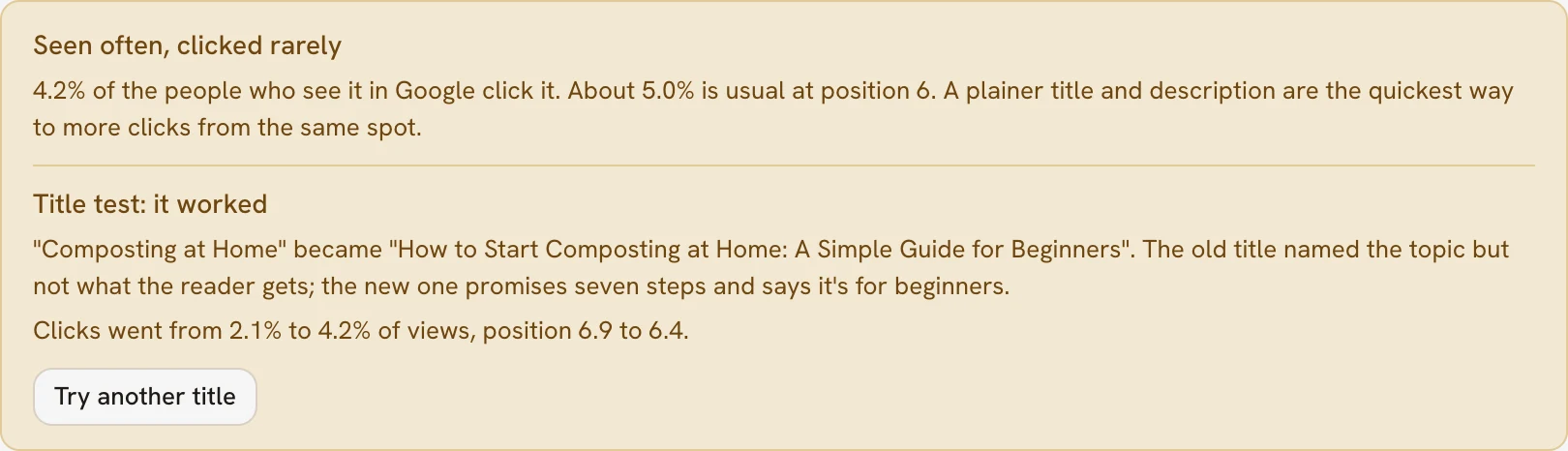
Few clicks for your spot means your page's click-through rate is well under what its average position usually earns, over enough impressions to trust. The position is fine; the title and description are not winning the click. It is the one ranking problem you can fix without changing the content of the page.
To check a page by hand, open Performance in Search Console, choose the last 28 days, click the page, and read its impressions, clicks and average position. Then compare the CTR with the curve above for that position and for whether the search shows an AI answer. We treat a page as underperforming when it earns under half the share its position usually earns and has been seen at least a hundred times. Fewer impressions and the rate is noise.
An example with Clockbird, a fictional time-tracking app. Its post on rounding billable hours sits at an average position of three. It was shown two thousand times in 28 days and clicked forty times, about two in a hundred. The curve puts position three at about 5.8 percent without an AI answer. Fewer than half the expected clicks, enough impressions, no AI answer on the search: the title is the problem.
PARCHMNT is a writing tool that researches what ranks for a search, writes the page, checks every claim and tracks where it lands in Google and AI answers. Its Search Console sync flags "few clicks for its spot" on exactly that test, and the flag leads to a title test rather than a rewrite.
How do you fix a low click-through rate with the title?
Fix a low click-through rate by rewriting the title and meta description to say plainly what the reader gets, with the keyword near the start and one specific detail. Then measure the rate two weeks later against the two weeks before. Google's advice for the title element is to "Write descriptive and concise text".
Google's title documentation adds "Avoid keyword stuffing" and "Brand your titles concisely". When Google detects an issue with a title, it "may try to generate an improved title link from anchors, on-page text, or other sources". For the description, Google says "Snippets are primarily created from the page content itself". It uses the meta description when that "gives users a more accurate description than would be possible purely from the on-page content". So the opening paragraph of the page is part of the fix too.
What we change in a title test, in order:
- Say what the reader gets, not what the page is about. "How to round billable hours (the six-minute rule)" beats "Billable hours rounding guide".
- Put the keyword near the start, in the words people type.
- Add one specific detail: a number, an outcome, an audience.
- Promise nothing the page does not deliver. A click that bounces is worth less than no click.
- Keep the old title so you can compare, and change nothing else for two weeks.
The measurement is the part most advice skips. Record CTR for the two weeks before, change the title, and read the two weeks after at the same position. A result of "no better" is a result; try once more, then accept the position's curve. Our post on writing a title tag that gets more clicks goes through the wording in detail.
When is a low click-through rate not a problem?
A low click-through rate is not a problem when the impressions come from searches the page was never meant to answer, when an AI answer or a block of images sits above you, or when the average hides a page-two position for most searches. Check those three before touching the title.
- Irrelevant impressions. Open the page's Queries tab. A page shown for searches it does not answer has a low rate for those, and the rate for its real search is what matters.
- Something above you. Search the query yourself. If an AI answer, a video carousel or a set of images sits above the first result, your rate is low along with everyone's.
- A misleading average. Google warns that the position value "can be misleading if you don't understand the subtleties". An average of 4 made from positions 1 and 7 is two different problems, neither of them the title.
Branded searches cut the other way. Searches for your business name click through at rates the curve never shows, and they inflate the page-level average. Filter them out before judging a page. Our guide to tracking where your pages rank for free covers the filters.
Key takeaways
- Google publishes no target click-through rate; the benchmark is the curve for your position, with or without an AI answer.
- Position one earns about 22.6 percent without an AI answer and about 3.6 percent with one, per First Page Sage's 2026 data.
- Pew measured 8 percent of visits clicking a result when an AI summary appeared, against 15 percent without.
- "Few clicks for your spot" means under half the clicks the position usually earns, over at least a hundred impressions; fix the title, not the page.
- Measure a title change for two weeks against the two weeks before, at the same position, and accept "no better" as an answer.
Frequently asked questions
Does click-through rate affect rankings?
Google has not documented click-through rate as a ranking factor, and nothing in its Search Central documentation says a higher rate moves a page up. Fix a low rate for the clicks it costs you today, which is reason enough. If a title that earns more clicks also happens to help the position, you will see it in the two-week comparison.
Is the Google Ads CTR benchmark relevant to organic results?
No. The benchmarks that circulate for Google Ads measure paid ads, which appear in a different place on the page, on different searches, with different wording rules. Most pages ranking for this search are about ads, which is why their numbers do not match what Search Console shows for an organic page. Use the organic curve by position.
What is a good CTR for a page on page two?
Close to zero, and that is normal. First Page Sage's curve puts position ten at about 0.2 percent, and page two is below that; most searchers never load it. A page-two page does not have a title problem, it has a position problem. Point internal links at it and improve the content before you judge its click-through rate.
What is a good click-through rate in Google search, in one sentence
A good rate is the rate your position earns on the curve, with or without an AI answer, and a page well under it has a title problem you can test in two weeks. If you would rather have the flag raised and the title test run for you, try one article free.
Sources
- First Page Sage's 2026 report
- The click count divided by the impression count
- Users who encountered an AI summary clicked on a traditional search result link in 8% of all visits
- the presence of an AI Overview now correlates with a 58% lower average clickthrough rate for the top-ranking page
- Write descriptive and concise text
- Snippets are primarily created from the page content itself
- can be misleading if you don't understand the subtleties
This post was written and checked with the same rules PARCHMNT applies to every page it writes for a customer: researched against what ranks today, answer first, every figure with a source.
Try 1 article free